








Instrumental exploitation
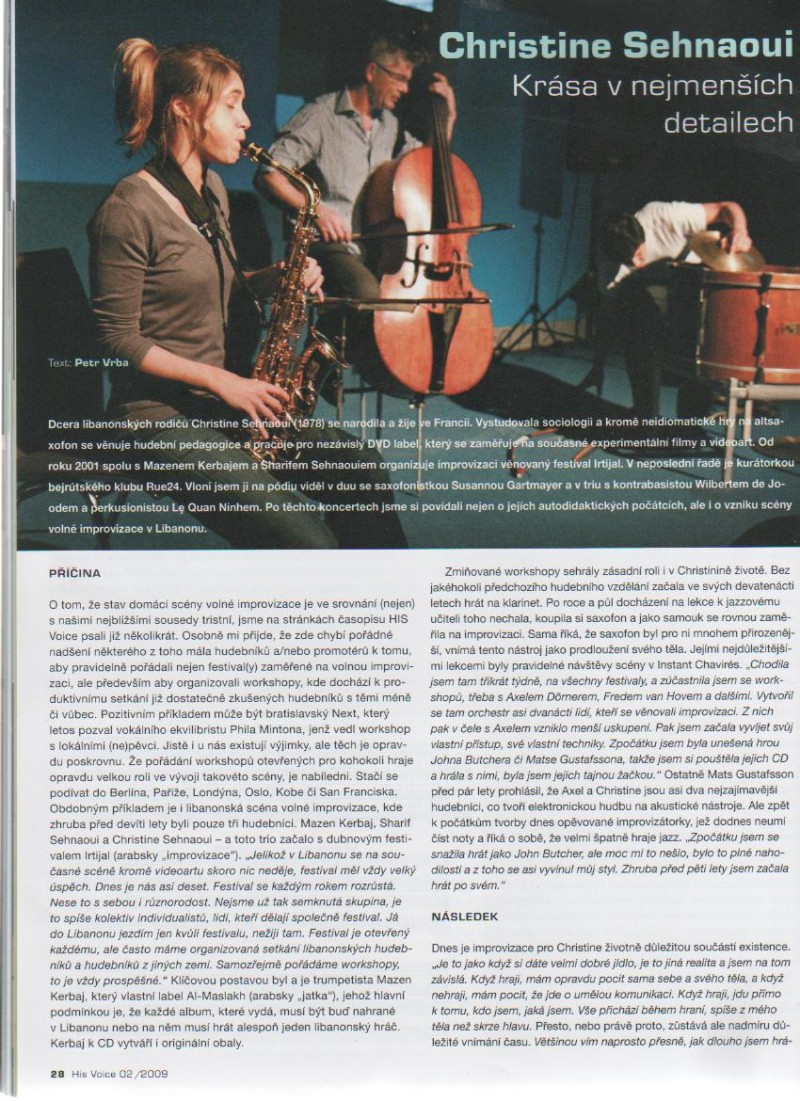
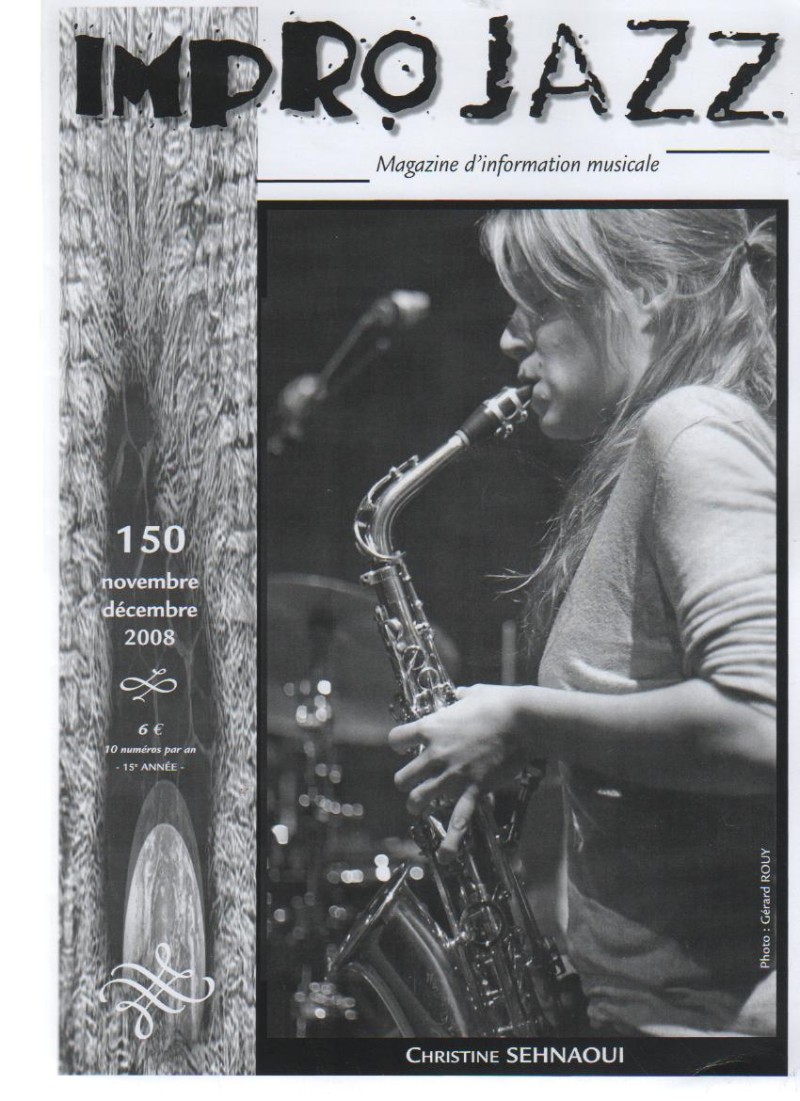
When Christine Abdelnour plays her saxophone she doesn't want it to sound like an acoustic instrument, in fact, she doesn't want it to sound like a saxophone at all. The French-based Abdelnour rejects orthodox techniques and established sounds in favour of un-pitched breaths, spittle-flecked growls, biting, slicing and echoes. You won't hear a story when Abedlnour's plays, instead you'll hear a physical exploration of time and space, you'll witness the transformative relationship between the player and the listener. Primarily a solo artist, Abdelnour has collaborated with Kernoa Ryan, Andy Moor, Magda Mayas, Pascal Battus and many others in various tours and projects and loves to participate in the visual arts, dance, theatre and poetry. While Abdelnour won't define the music she makes, she has played within many genres including free jazz, rock, electronica and noise.
When did you start playing your instrument, and what or who were your early passions or influences?
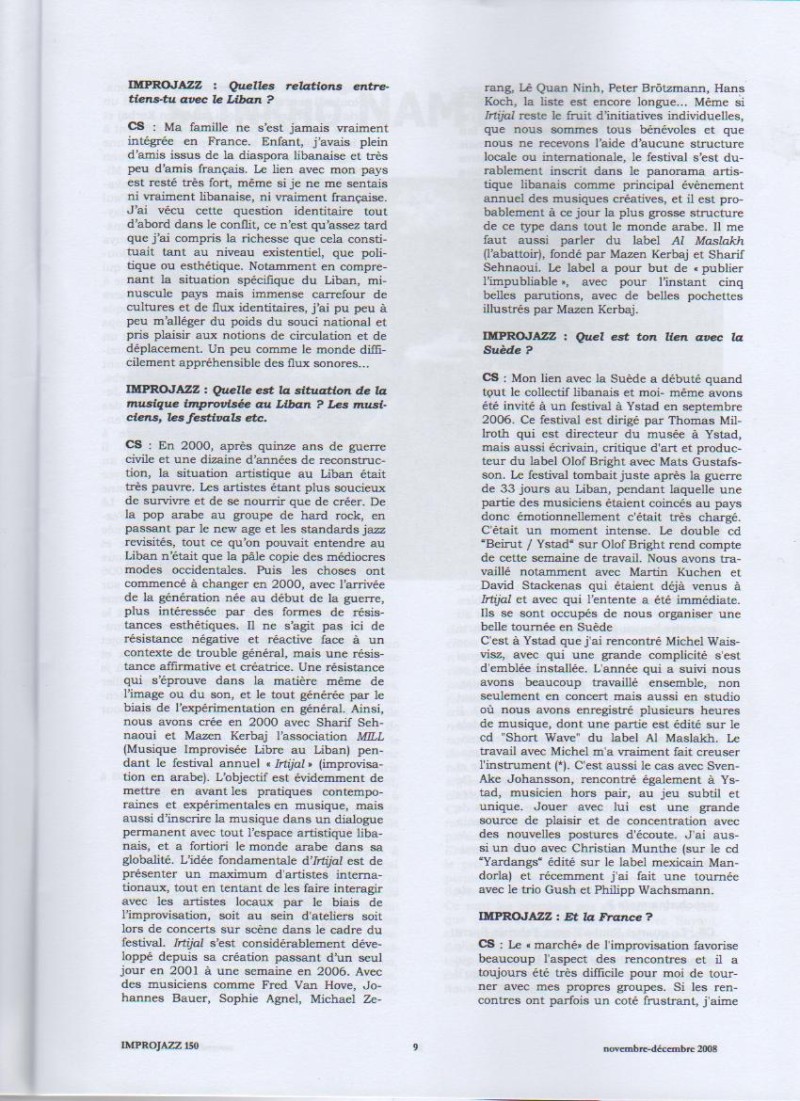
In 1997, I got attracted to improvised music. When I was young, I did a little bit of classical music on piano and guitar but it was too strict for me. Then, when I was 18, I started directly with improvised music on the clarinet and the saxophone. I did some improvised music workshops and then I entered the orchestra of Instants Chavires in Paris. The Instants Chavires was the place to be for that kind of music. I was going there two or three times a week to listen to concerts and I practiced there too through workshops. In that period, I was very impressed by saxophonists like John Butcher, Evan Parker, Peter Brotzmann or Mats Gustaffson.
I learned some techniques, just by listening to their solos on CDs and trying to reproduce the same sounds. Then, I felt more attracted by electro-acoustic or purely electronic music and I tried to get rid of the specific sounds of the saxophone itself . The more I was playing, the more I got frustrated by the instrument and I tried to find ways to escape the instrument. I tried to develop my own techniques and now I hope that I don't sound at all like a saxophone. I'm trying to produce sounds that are close to those of electro acoustic music but on a purely acoustic instrument.
But sometimes, when I listen to music at home, I don't think about all this at all. For example, I never listen to improvised music at home. I don't listen to jazz and I won't define my music as jazz. I listen to all sorts of music, read all kind of books and watch all kind of movies. I'm not a fetishist of anything and I don't feel related to any kind of musical history.
What do you personally consider to be the incisive moments in your artistic work and/or career?
My duo with Michel Waisvisz was very important for me. With him, I started to play with electronic music. His playing was amazing because it was not just flat and virtual electronic music but his body was really involved. His music was wonderful in rethinking music and the relationship to the body. So it has inspired me to play something different, like how can I sound like him with my acoustic instrument.
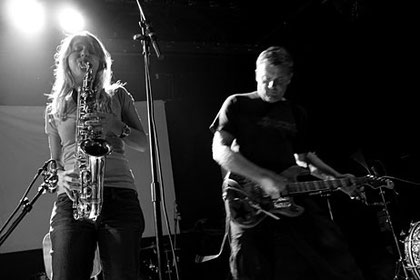
My duo with Andy Moor is also very special for me. It is the more improvised duo because sometimes I really don't know which direction we are going. Our music is very rock in terms of energy and quite intense for me physically. We play a lot with the presence of the amp, feedbacks, it is very electric and "no-jazz" but at the same time there is this kind of minimalist repetition and irregular rhythm. Our music is very open and versatile.
My duo with Magda Mayas, was also a big thing for me. Magda is like my alter ego in music. We sound immediately in tune, we are so locked into each other that it's unclear who's doing what sound. This fluidity in our dialogue allows us to bring together intensity and inventiveness, sharpness and softness. It is quite a unique experience.
My duo called Split Second with Ryan Kernoa is also fundamental for me. Our music is made of multiple frequencies, pulsations, interferences between different harmonics that creates the particular effect of 'beating'. The aim is to let the listener perceive lines and shapes in the music, appearance and disappearance of vibration. It is all about disorder and confusion: the sound stands still and begins to live inside the one who listens. It is difficult to classify the music of Split Second. We appeal alternately to sound techniques referring to minimalism but also, due to our work on frequencies, the drones or feedback of electro-acoustic music or even rock music. The duet unwinds a sound space combining sharp and low sounds, dense and continuous frequencies which evolve very subtly in time. Our music exploits the space in all its directions: depth, height, but also the invisible space of silence.
What are currently your main artistic challenges?
I would love to go beyond the idea of a simple concert. For me it is too limited and often frustrating. I would like to record more. I would love to be involved in a more global project in order to analyse how music can be related to theatre, visual art, literature or dance.
What do improvisation and composition mean to you and what, to you, are their respective merits?
In my music, I'm interested by sound itself but the important thing for me is the creation and the construction of a shape. This work in progress that will build the music is primordial for me.
How a sound will emerge? What is the purpose of a sound, its laws of movement? Do the musician create the shape or is it the shape which creates the musician? Beyond my work on sounds as a multiplicity of techniques, what interest's me when I improvise is to try to analyse how the brain works in music. I'm more and more against this romantic idea that improvising is only related to the body of the musician, that would just feel the music without any intentions. I'm convinced that the brain is also very active in this process, that it's a decision and a will that will conduct the music. When the musician feels or perceives, he is theorising at the same time and his brain obeys to some codes in a causal system.
Music is a language. Language has some codes. Moreover, music is a structural system or an organism where every sound interrelates. Every sound that we produce has to be stretched towards a change in the shape or has to pass on some information. No sounds have to be anecdotic or useless. The musician has to be always in a state of mind of urgencies that results from the process of listening. Playing when it's just necessary and being precise and concise. Less is more. I can't think of music without the concept of listening: to listen is a gesture of composition.
How important are practising and instrumental technique for achieving your musical goals?
Practising is not so important for me. I must say that I don't practise at all. All my techniques are inside me. The more important thing for me is being in the right state of mind. Being focused and open in order to listen.
The wind itself
Derek Bailey defined improvising as the search for material which is endlessly transformable. Regardless of whether or not you agree with his perspective, what kind of materials have turned to be particularly transformable and stimulating for you?
I approach sound as a malleable material, rich in concrete textures, which combine breath, silence and countless acoustic distortions. I'm exploring the microtonal aspects of the saxophone and its high-pitched tones, but also tonguing techniques, unpitched breaths, growls, sliced notes and breathy echoing sounds.
Also, for me, six codes or abstract parameters are important in the process of improvising:
- The time or the duration of a sound.
- The choice of the timbre in the surface in the pitch.
- The precision in the locations and the proportions.
- The density in the choice of volume or frequency.
- The intention or the dynamics.
- The articulation or transitions.
It was a long process for me to develop these parameters. It took me all my life to develop those ideas. But it's a process with no end, so it can change anytime.
There is a famous saying "ce qui compte ce n'est pas l'énoncé du vent, c'est le vent" that can be translated by "it's not how you say the wind that matters, but the wind itself". This is a little bit how I live the music.
Purportedly, John Stevens of the Spontaneous Music Ensemble had two basic rules to playing in his ensemble: (1) If you can't hear another musician, you're playing too loud, and (2) if the music you're producing doesn't regularly relate to what you're hearing others create, why be in the group. What's your perspective on this statement and how, more generally, does playing in a group compare to a solo situation?
The duo is for me the easiest and the most beautiful group. It is like an exchange. If you put four persons in a room, the conversation will be less fluid and more difficult. There will be alliances, disagreements. Improvised music is like a social network. Being two or being alone is sometimes easier.
I like also to play in a solo context. Actually, solo doesn't really exist because in solo, the room where you play becomes a partner too. The acoustic aspect of the room is important. Whether it's a dry place, a very resonant one or a noisy one, these factors can bring unexpected results. Also, the time, the weather or the accidents caused by the public can be a source of influence. Usually, I prefer to play inside in a very silent environment with a little bit of resonance. I like to be surrounded by the audience and not on a stage.
In solo, the concentration is also very different. Knowing that everything can happen in a visible and quantifiable geometry. Every sound, every gesture is important. The question is, why and how? What I am going to make now is going to change everything. How is it going to dictate the continuation to me? How can I go in and how can I go out of the shape? How does each sound have a secret tendency for the whole without ever being able to create the totality?
Some people see recording improvised music as a problem. Do you?
Absolutely not!! I would love to have more time to experiment with different recording, to use different mics, try different mixes ...
I'm very frustrated to be always on the road for concerts and not have more time for a residency where I can record what I want.
A living thing
In the 20th century, the relationship between music and other forms of art - painting, video art and cinema most importantly - has become increasingly important. How do you see this relationship yourself and in how far, do you feel, does music relate to other senses than hearing alone?
When I listen to a sound, sometimes I can see colours or lights. When I look at an image, I can hear a sound. When I listen to certain kinds of music, I can feel that I'm standing in different geometrical forms and architectural spaces.
Beyond academic divisions, I can't ignore the growing relationship between the plastic arts and music in the world of contemporary art: the so-called 'sound art' where space is taken as a full dimension of a musical project and where time becomes a concrete component of a plastic work. I love this idea of an architectural space that takes its existence in a specific time and becomes like a living body where all the senses are working together.
In how much, do you feel, are creative decisions shaped by cultural differences - and in how much, vice versa, is the perception of sound influenced by cultural differences?
I think that with globalisation, there are less and less cultural differences. I like the idea of an emergency in ethno-musicology, which invites us to protect the numerous musical directories that are disappearing before our eyes.
Do you feel it important that an audience is able to deduct the processes and ideas behind a work purely on the basis of the music? If so, how do you make them transparent?
Improvisation allows the audience to assist with a live process. Sometimes, I like to make very obvious transitions but I believe the musical beauty comes from the surprise, when you disturb the listener in their interior listening. Nobody expects it, and the music takes a strange turn.
Usually, it is considered that it is the job of the artist to win over an audience. But listening is also an active, rather than just a passive process. How do you see the role of the listener in the musical communication process?
The environment is very important. Music is like a landscape. You have to lay down a network and then move with sounds within this network. The question of energy and emergence is fundamental. By penetrating the space, the public feeds it and makes it leave too.
Music-sharing sites and -blogs as well as a flood of releases in general are presenting both listeners and artists with challenging questions. What's your view on the value of music today? In what way does the abundance of music change our perception of it?
Contrary to some musicians who criticizes the excessive digital consumption of poor quality MP3 music, or in the face of hackers who "kill artists", I think the abundance of music is very positive. It promotes democratization of music and its access to the greatest number. It's now possible to have access to very rare resources and to discover artists more easily. I listen to a lot of music on websites like Deezer, Spotify or Myspace. It allows me to discover artists that I would have never discovered without the Internet. Besides, my own music also becomes more accessible due to Facebook or Myspace. I get often emails from people who discover my work by coincidence.
Objectively, the Internet doesn't kill anyone, it doesn't steal anything and instead it allows the exchange of culture between communities and networks of friends. The artists get together more easily through networks according to their aesthetic, political and artistic affinities, and this is very positive to me. It is also easier to produce music and get in touch with an audience. Traditional media like CDs etc. is renewed and it's great.
Please recommend two artists to our readers which you feel deserve their attention.